GUIDE
Data Extraction Checklist for Systematic Reviews and Meta-Analysis
A field-by-field checklist for what to capture from each included study—before a single number gets copied into a pooled estimate.
Published October 3, 2026
Missing a field at extraction time almost always means re-opening a PDF weeks later, under time pressure, to find a number nobody recorded. This checklist is organized the way extraction actually happens—study by study, field by field—so nothing has to be reconstructed later.
Get the free extraction table templateData extraction is where a systematic review stops being a list of included studies and becomes a dataset you can actually pool.
It is also where small omissions compound. A missing sample size, an unrecorded unit, or a standard deviation that was never distinguished from a standard error does not usually surface until analysis—by which point tracking it down means reopening a PDF, or worse, emailing a study author who may not reply.
This checklist groups what to extract into the categories that actually matter for pooling and reporting: identification, methods, population, intervention, outcomes, and the specific details that feed a Cochrane RoB 2 judgement. Treat it as a floor, not a ceiling—a protocol-specific review will always need fields this general checklist cannot anticipate.
Before you extract anything: align to the protocol
Extraction fields should be decided before the first study is opened, not discovered one study at a time. Pull three things directly from your protocol or PICO:
- The pre-specified outcomes, in the order you intend to report them.
- Whether each outcome is dichotomous (events/total) or continuous (mean/SD/N), since that determines which columns the extraction table needs.
- The comparison(s) you plan to pool—extracting the wrong arm as the comparator is a common, late-discovered error in multi-arm trials.
EvidenceFlow’s free extraction table template starts from this exact column set, with a worked example filled in.
1. Study identification
Capture this once, correctly, and every later table and citation reuses it without re-checking the paper.
| Field | Why it matters |
|---|---|
| First author, year, journal | Standard citation and the label used on every forest plot row. |
| DOI and/or PMID | The unambiguous identifier - titles alone cause duplicate-study errors. |
| Country / setting | Needed for subgroup or sensitivity analysis by region or care setting. |
| Funding source and conflicts of interest | Required for several risk-of-bias and GRADE judgements, and increasingly expected by journals. |
| Linked reports | Note every other publication (protocol, follow-up paper, conference abstract) describing the same underlying study, so it is never double-counted. |
2. Study design and methods
This section is also where most of the raw material for a risk-of-bias judgement actually gets captured—extract it in enough detail to answer the RoB 2 signalling questions later, not just a design label.
| Field | Capture detail, not just a label |
|---|---|
| Study design | RCT, cluster-RCT, crossover, cohort, case-control - the design changes which effect measures are even valid. |
| Randomization method | The actual sequence-generation method described (computer-generated, random number table), not just "randomized." |
| Allocation concealment | How assignment was concealed until enrollment - central allocation, sealed envelopes, or not reported. |
| Blinding | Who was blinded - participants, personnel, outcome assessors - and how. |
| Sample size calculation | Whether one was reported, and whether the achieved sample met it. |
| Follow-up duration | The actual duration, not just "short-term" or "long-term." |
| Attrition / loss to follow-up | Numbers and reasons, per arm - this is the raw material for RoB 2 Domain 3. |
3. Population characteristics
- Total sample size, and sample size per arm.
- Age (mean/median and range or SD) and sex/gender distribution, per arm if reported separately.
- The specific inclusion and exclusion criteria actually applied by the study - not the review’s own criteria.
- Baseline comparability between arms - an imbalance here is a direct input to RoB 2 Domain 1.
4. Intervention and comparator
Vague intervention descriptions are one of the most common reasons a meta-analysis gets challenged at peer review. Record enough that someone who has never read the paper could describe what was actually compared.
- Intervention: dose, frequency, duration, and delivery method.
- Comparator: placebo, active comparator, usual care, or waitlist - and what that actually consisted of.
- Co-interventions permitted in either arm, if the paper reports them.
5. Outcome data - the fields that actually get pooled
This is the section worth the most care, because the raw numbers determine which effect measures are even computable. Prefer raw counts or summary statistics over a pre-calculated effect size whenever the paper reports both.
| Outcome type | Fields to extract per arm |
|---|---|
| Dichotomous (binary) | Events and total N - e.g. 24/120 vs 41/118 - not just the reported percentage. |
| Continuous | Mean, standard deviation, and N - and confirm whether the paper reported SD or SE, since mixing them silently halves or doubles the apparent variance. |
| Already-computed effect size | OR, RR, MD, or SMD with its CI or SE, and the statistical model the paper used to produce it - only use this when raw counts or means/SDs are not reported at all. |
| Outcome measurement | The instrument or definition used (e.g. which pain scale, which diagnostic threshold) and the timepoint it was measured at. |
Never back-calculate a raw count from a percentage and a sample size to fill a gap, and never fabricate an effect size when only raw counts are available - record what the paper actually reports, and flag what it does not.
6. Missing data and provenance
- If an outcome is missing for some participants, record how many and why - this is the raw material for RoB 2 Domain 3, not a footnote to skip.
- For every number that will enter a forest plot, note where it came from - page number, table number, or figure - so a disagreement at analysis time is a two-minute lookup instead of a re-read of the full text.
Common extraction mistakes this checklist exists to prevent
- Recording a percentage instead of the raw event count and denominator.
- Not distinguishing standard deviation from standard error.
- Extracting from the wrong comparator arm in a multi-arm trial.
- Treating a conference abstract and its later full publication as two separate studies.
- Copying a published OR or RR when the paper also reports raw counts that would let the review compute it consistently with every other included study.
- Leaving a field blank instead of recording "not reported" - a blank looks like an oversight; "not reported" is itself a finding.
Dual extraction and reconciliation
Where resources allow, two reviewers extracting independently and reconciling disagreements catches far more errors than a single extractor, however careful. At minimum, a second reviewer should verify the outcome data and risk-of-bias fields on a random sample of included studies, since those are the fields most directly feeding the pooled result.
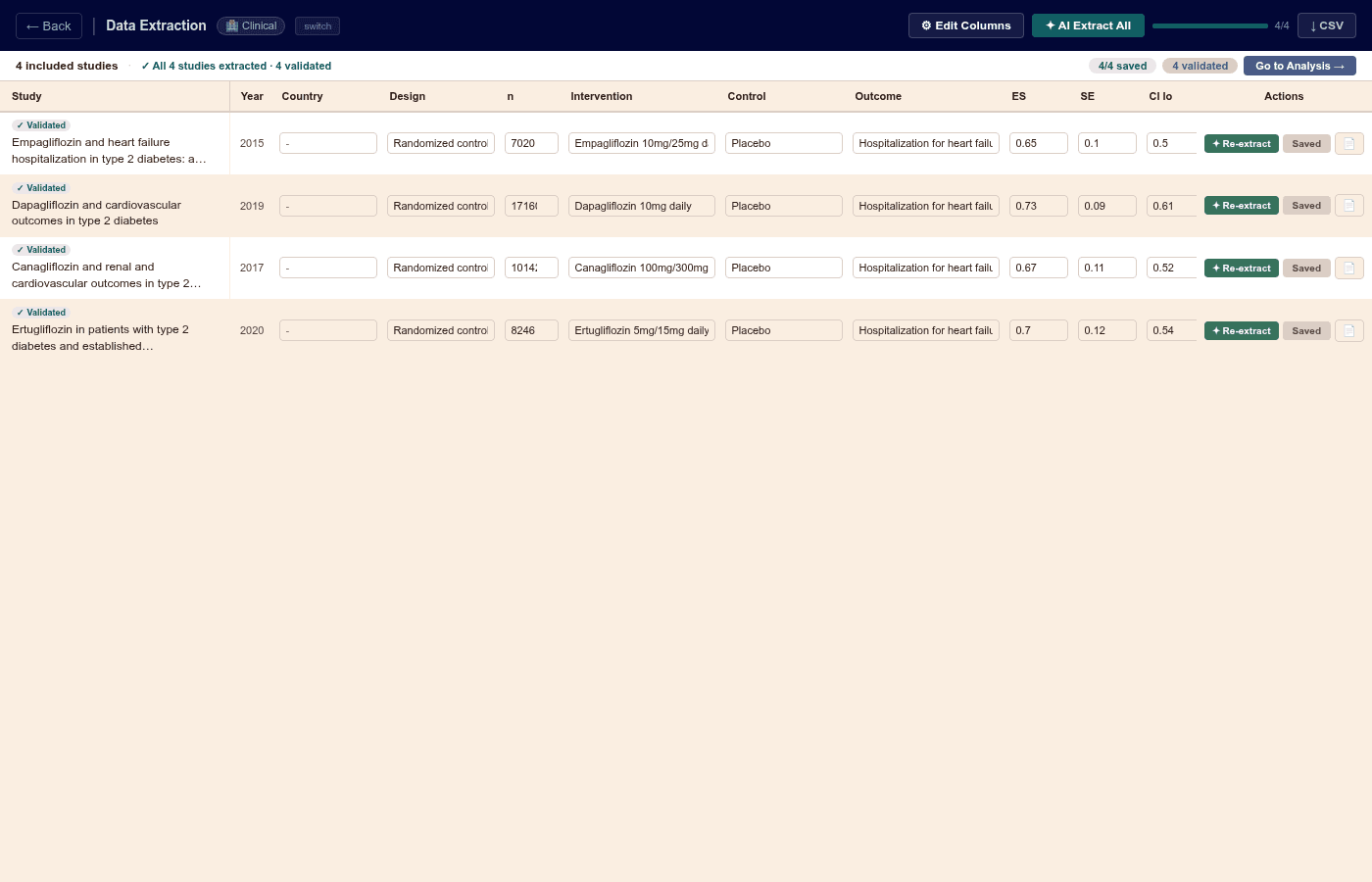
Turning this checklist into a working table
A checklist tells you what to capture; a table is where you actually capture it. EvidenceFlow’s free data extraction template is this exact field set, already laid out in Excel and CSV, with a worked example filled in so you can see the expected format before starting your own.
For reviews with a dual-review workflow, AI auto-fill, or risk-of-bias assessment built around the same records, continue with the full data extraction and risk-of-bias guide.
Get the free extraction table template
Every field in this checklist, already laid out and ready to fill in.
EvidenceFlow supports structured clinical and omics extraction forms, optional AI auto-fill, and Cochrane RoB 2 assessment in the same workspace as screening and meta-analysis.