SYSTEMATIC REVIEW GUIDE
Which Systematic Review and Meta-Analysis Tool Should You Use in 2026?
A practical comparison of tools for literature screening, dual review, data extraction, PRISMA reporting, and statistical synthesis.
Choosing software for a systematic review or meta-analysis depends on where your team's real bottleneck is - screening thousands of records, keeping extraction consistent across reviewers, producing a reconciled PRISMA 2020 diagram, or running a defensible pooled analysis - as well as team size, statistical needs, budget, and your institution's data-governance requirements. Increasingly, tools also offer AI-assisted screening or extraction suggestions; these can meaningfully speed up the mechanical parts of the work, but they don't replace a reviewer's judgment about whether a study belongs in the review or whether an extracted value is correct.
On this page
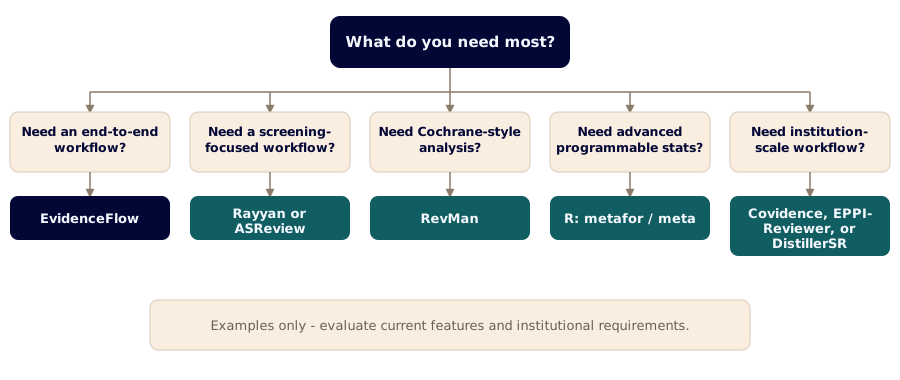
Quick answer
Use this table as an evaluation starting point, not an endorsement - match it to your own workflow before deciding.
| Need | Tool category to evaluate |
|---|---|
| End-to-end screening, extraction, PRISMA and pooled analysis | EvidenceFlow |
| Collaborative screening and study selection | Rayyan |
| Institution-supported review workflow | Covidence |
| Cochrane-style authoring and meta-analysis | RevMan |
| Active-learning-assisted screening | ASReview |
| Enterprise or regulated evidence synthesis | DistillerSR |
| Complex review / evidence mapping | EPPI-Reviewer |
| Advanced reproducible statistical analysis | R: metafor / meta |
Systematic review vs meta-analysis
The two terms are often used together but describe different things. A systematic review can stand alone; a meta-analysis usually depends on one having been done first.
| Aspect | Systematic review | Meta-analysis |
|---|---|---|
| Main purpose | Identify and appraise relevant evidence | Combine comparable quantitative findings |
| Main work | Protocol, search, screening, extraction, appraisal and reporting | Effect sizes, pooling, heterogeneity and visualizations |
| Can be qualitative? | Yes | Usually requires compatible quantitative data |
| Always required? | No | No |
| Relationship | May include a meta-analysis | Usually benefits from systematic evidence identification |
What to look for in a tool
Whatever you choose, evaluate it against the mechanics that actually determine whether a review is reproducible and defensible:
- Imports and deduplication - which formats it accepts, and whether duplicate records are handled automatically.
- Independent / dual screening - whether two reviewers can screen blind to each other's decisions.
- Conflict resolution - how disagreements between reviewers get surfaced and resolved.
- Data extraction - structured fields vs. free text, and whether two extractors can be reconciled.
- Audit trail - can you reconstruct who decided what, and when.
- PRISMA 2020 support - generated automatically from your workflow, or assembled by hand.
- Supported effect measures - odds ratio, risk ratio, risk difference, mean difference, standardized mean difference.
- Fixed vs. random effects - and whether the choice is yours to make, not fixed by the tool.
- Heterogeneity reporting - Cochran's Q, I², τ² reported alongside the pooled estimate, not hidden.
- Export and reproducibility - can someone else re-derive your numbers from what the tool exports.
- Privacy and data governance - where your data is hosted and who can access it, particularly for institutional reviews.
- Cost and team access - per-seat licensing, review-count caps, and whether collaborators need their own paid account.
Main comparison table
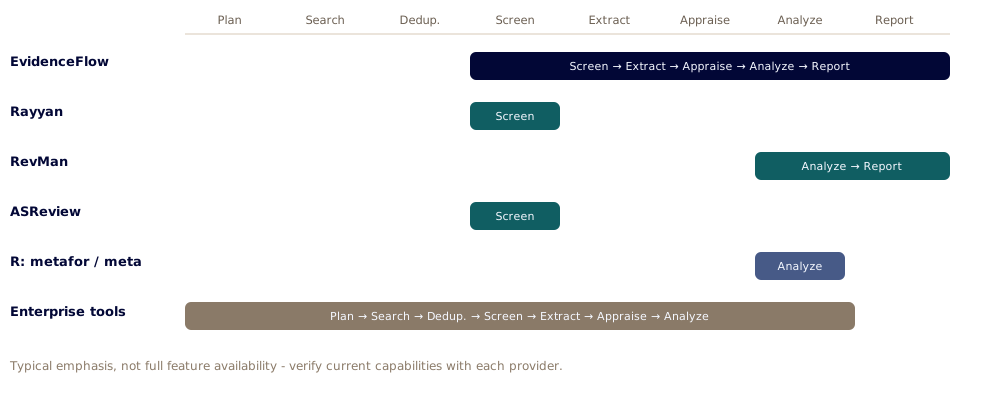
Feature availability changes over time - verify current plan details directly with each provider before deciding.
| Tool | Screening | Dual review | Data extraction | PRISMA reporting | Meta-analysis | Best for |
|---|---|---|---|---|---|---|
| EvidenceFlow | Yes, incl. optional AI-assisted scoring | Yes, configurable blind reviewers | Yes, incl. clinical + omics fields | Yes, generated automatically | Yes - fixed/random effects, forest/funnel plots | Teams wanting screening through pooled analysis in one workspace |
| Rayyan | Yes - core strength | Yes ("Blind Mode") | Basic - verify current plan | Yes | No - typically exported to a separate tool | Screening-focused teams |
| Covidence | Yes | Yes | Yes - verify current plan | Yes | No - typically exports to RevMan Web | Institutional / enterprise review teams |
| RevMan | Not a core feature | N/A - no screening module | Structured tables, manual entry | Yes, from manually entered data | Yes - Cochrane-standard | Cochrane-style authoring and analysis |
| ASReview | Yes - active-learning assisted | Varies by workflow and plan | Not a core feature | Not a core feature | Not a core feature | Screening-focused, open-source |
| EPPI-Reviewer | Yes | Yes | Yes | Yes | Some synthesis features - verify current plan | Complex reviews and evidence mapping, institutional / enterprise |
| DistillerSR | Yes | Yes | Yes | Yes | Varies by workflow and plan | Enterprise / regulated evidence synthesis |
| R: metafor / meta | Not applicable | Not applicable | Not applicable - analysis only | Not built in | Advanced / code-based | Reproducible, custom statistical analysis |
EvidenceFlow: integrated evidence-synthesis workflow
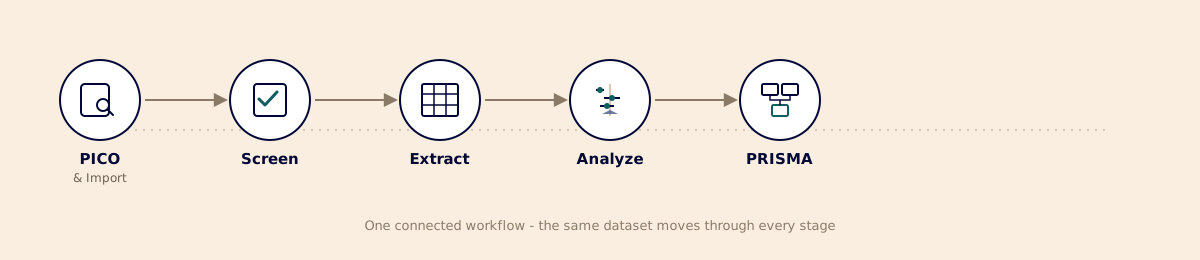
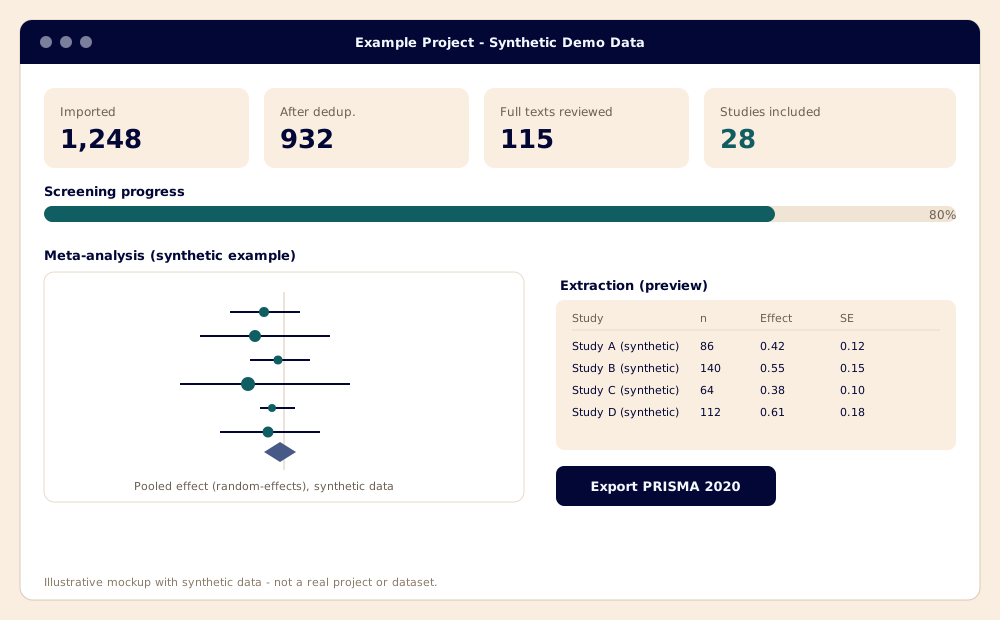
EvidenceFlow covers title/abstract and full-text screening with blind dual review and conflict resolution (third reviewer, review manager, or consensus), structured data extraction with clinical and omics fields, automatic PRISMA 2020 reporting generated from your team's actual screening decisions, and built-in fixed-effect and random-effects meta-analysis with effect sizes, Cochran's Q, I², τ², and forest/funnel plots. Imports accept RIS, BibTeX, CSV, and PubMed XML exports, plus direct PDF upload for full-text screening; exports include CSV and Excel extraction data, PRISMA diagrams as PNG or PDF, and an AI-assisted manuscript draft as a single .docx file.
The core workflow - import, screening, extraction, meta-analysis, and PRISMA reporting - is free with no review-count or seat limit. AI-assisted screening suggestions, extraction auto-fill, and AI manuscript drafting are an optional paid upgrade.
Rayyan
Rayyan is commonly evaluated for systematic-review and literature-review screening and collaborative study selection, including a widely used blind dual-screening mode. Teams should verify current data-extraction, reporting, analysis, pricing, and plan features directly with Rayyan, since these are the areas most likely to differ from an end-to-end workflow.
Covidence
Covidence is commonly considered by institution-supported review teams, particularly where an organization already has a site license. Evaluate institutional access, training requirements, extraction and reporting features, integrations with other tools, and data-governance terms before committing a review to it.
RevMan
RevMan (Review Manager) is commonly associated with Cochrane-style review authoring and meta-analysis, and is a strong option to evaluate for conventional clinical-review statistical workflows - particularly if the review is intended for Cochrane publication, where its use is often a requirement rather than a choice.
ASReview
ASReview is an open-source tool built around active-learning-assisted screening: it reorders your citation list based on relevance signals from your own inclusion/exclusion decisions as you screen. It is primarily screening support rather than a full end-to-end review workflow, so extraction, reporting, and analysis typically happen elsewhere.
EPPI-Reviewer and DistillerSR
EPPI-Reviewer and DistillerSR are both commonly evaluated for complex or high-volume reviews, evidence mapping, and organizational workflows that need formal governance, audit, and support arrangements. That same institutional depth can make either tool more complex than a small team or a single-reviewer project actually needs - worth weighing against a lighter-weight tool if your review doesn't require that level of process.
R: metafor and meta
The metafor and meta packages in R offer advanced, reproducible, code-based statistical analysis - meta-regression, specialized pooling models, and fully custom analyses that a point-and-click tool may not expose. They require programming and statistical capability to use well, and neither provides a screening or extraction workflow on its own; most teams pair them with a separate screening/extraction tool and bring the extracted data into R for the analysis stage.
Software cannot make a review valid
Every tool in this comparison, EvidenceFlow included, automates mechanics - it does not make methodological judgments for you. None of this replaces a statistician, a methodologist, peer review, ethics approval, or clinical judgment.
| Software can help with | Software cannot decide for you |
|---|---|
| Importing and organizing citations | Whether your question is meaningful |
| AI prioritization suggestions | Whether a study should be included |
| Effect-size calculations | Whether outcomes are comparable |
| Forest plots | Whether pooling is appropriate |
| I² / Q / τ² | Why heterogeneity exists |
| PRISMA diagrams | Whether searching was comprehensive |
| Exports and audit trails | Whether conclusions are clinically valid |
How to choose
Choose EvidenceFlow if you want screening, extraction, PRISMA reporting, and meta-analysis connected in one workspace, without re-entering data into a second tool for the analysis stage.
Choose a screening-focused tool (Rayyan, ASReview) if screening throughput is your main bottleneck and you already have an analysis workflow you're happy with.
Choose RevMan or R if you need Cochrane-standard authoring or advanced, code-based statistical models beyond what a point-and-click tool exposes.
Choose institution-supported software (Covidence, EPPI-Reviewer, DistillerSR) when formal governance, training, and vendor support matter more than workflow breadth.
Free EvidenceFlow tools
Each of these runs in your browser with no account or payment required:
PRISMA 2020 Flow Diagram
Generate a PRISMA 2020 diagram from your own counts and export PNG or PDF.
Use free tool →Data Extraction Template
A structured extraction form with PICO, 2×2 counts, and effect-size fields.
Use free tool →Title/Abstract Screening Guide
A dual-review screening workflow plus a practice worksheet.
Use free tool →Effect Size Calculator
Cohen's d, Hedges' g, odds ratio, risk ratio, or risk difference.
Use free tool →Protocol Template
A PRISMA-P-style protocol covering PICO, eligibility, and synthesis.
Use free tool →I² Calculator
Cochran's Q, I², and τ² from your study effect sizes and standard errors.
Use free tool →Sample Size Calculator
Required participants per group for two proportions or two means.
Use free tool →FAQ
What is the best systematic review software in 2026?
There isn't one answer - it depends on whether your bottleneck is screening, extraction, statistical synthesis, or coordinating a large institutional team. EvidenceFlow, Rayyan, Covidence, RevMan, ASReview, EPPI-Reviewer, DistillerSR, and R's metafor/meta packages each fit different parts of that workflow; this article's quick-answer table is a starting point for narrowing that down, not a single verdict.
Is EvidenceFlow an alternative to Rayyan?
For screening, yes - the core workflow is comparable. EvidenceFlow additionally includes built-in meta-analysis, which Rayyan does not offer directly; Rayyan is commonly evaluated for a dedicated risk-of-bias module and its mobile screening app. Verify current features and plan limits with Rayyan directly before deciding.
Can I conduct a meta-analysis without a systematic review?
Technically you can pool numbers from any set of studies, but doing so without a systematic, documented search and screening process undermines the reason a meta-analysis is trustworthy in the first place - you can't rule out that the studies you pooled are a biased subset of the evidence. Most methodologists treat rigorous evidence identification as a precondition for a meaningful pooled estimate, not an optional add-on.
Does AI make a systematic review accurate?
No. AI features in tools like EvidenceFlow can speed up screening prioritization or suggest extraction values, but every suggestion still needs a human reviewer to check it against the original study and the pre-specified protocol. AI assistance changes how fast you work, not whether the review's conclusions are sound - that still depends on the underlying methodology.
Can I use EvidenceFlow for free?
The core workflow - import, screening, extraction, meta-analysis, and PRISMA reporting - is free with no review-count or seat limit. AI-assisted screening suggestions, extraction auto-fill, and AI manuscript drafting are an optional paid upgrade.
When should I avoid meta-analysis?
When the included studies measure different populations, interventions, or outcomes in ways that aren't meaningfully comparable, or when there's substantial unexplained heterogeneity (a high I² without a clear subgroup explanation). In those cases a narrative synthesis that says so explicitly is more honest than forcing a pooled number onto incompatible studies.
References and further reading
- PRISMA 2020 statement
- Cochrane Handbook for Systematic Reviews of Interventions
- Rayyan
- Covidence
- RevMan
- ASReview
- EPPI-Reviewer
- DistillerSR
The best tool is the one that supports a transparent, reproducible workflow matched to your research question and your team - not necessarily the one with the most features. Whichever you choose, the methodology underneath still has to hold up on its own; see the full step-by-step guide to conducting a systematic review for that part, and the EvidenceFlow documentation or about page for more on how EvidenceFlow itself is built.